
Yes, a buyer can assume a seller’s existing mortgage in Spain through subrogación de deudor, but only if the lender approves the new borrower’s finances. If the bank says no, the seller cancels the loan and the buyer arranges fresh financing. In developer sales, subrogating into the promotor’s master loan is common. Either way, the first move is asking the seller’s bank for a certified statement of the outstanding debt and pricing that against a new mortgage offer.
TL;DR:
- Subrogation de deudor allows buyers to assume an existing mortgage if the bank approves their financial profile, potentially saving setup costs and taxes.
- The bank typically issues a debt certificate within seven days, with a further 15 days for a formal counteroffer that can lead to renegotiation.
- Costs for subrogation include a commission fee, valuation, notary, property registry, and administrative fees, but it often avoids the Impuesto sobre Actos Jurídicos Documentados (IAJD).
- If the bank refuses the subrogation, the seller must cancel the mortgage, and the buyer will need to arrange new financing, which may extend the closing process.
- Developer subrogation is common in new builds, but buyers should verify loan terms, request independent valuations, and confirm registration procedures before proceeding.
Table of Contents
- What Is Subrogación Hipoteca and Which Type Applies to You?
- How Does the Subrogation Process Work for a Buyer?
- What Does Subrogating a Mortgage Cost in Spain?
- Should You Assume the Mortgage or Get a New One?
- Buying From a Developer: What to Check Before Subrogating
- What Documents Do Banks Require for Subrogation Approval?
- Signing Day: Notary Steps and What Happens If the Bank Says No
- Practical Tips From SteraM Flats and Legal Experts
- How a real estate agency can help buyers through subrogation
- Get a Financing Check Before You Commit to a Subrogation
- Sources
- FAQ
What Is Subrogación Hipoteca and Which Type Applies to You?
Subrogación hipoteca comprador means substituting the debtor or the creditor on a mortgage without canceling the underlying loan. The loan itself survives; only one party to it changes. Spanish law and bank practice split this into two distinct mechanics, and a third scenario shows up constantly in new-build sales.
- Subrogación de deudor: you step into the seller’s existing mortgage, taking on their debt, interest rate, and remaining term. This can avoid the setup costs and part of the tax bill you’d pay opening a brand-new loan.
- Subrogación de acreedor: the loan itself moves from one bank to another, usually because the borrower wants better terms. This applies more to owners refinancing than to buyers, but it explains why some sellers already switched lenders before listing.
- Promotor (developer) subrogation: developers finance entire building projects with one master loan, then split that debt into shares assigned to each unit once the property is registered. Buyers are frequently offered the chance to assume that allocated share instead of arranging independent financing.
Knowing which of these three you’re actually being offered changes everything about your negotiating position.
How Does the Subrogation Process Work for a Buyer?
The mechanics follow a fairly rigid bank sequence, and knowing the timeline gives you real leverage during negotiations.
- Request the debt certificate. Ask the seller for the bank’s certified statement of the outstanding mortgage balance and the deed reference number. You need this before anyone can compare numbers.
- Submit your buyer file. Send your documentation to the lending bank, or to competing banks if you’re shopping the offer. Expect the same paperwork a fresh mortgage application demands: income proof, tax returns, and existing debt disclosures.
- Wait on bank-to-bank timing. The current lender must issue the certificate of debt within about seven days of a formal request, and it then has up to 15 days to present a counteroffer if it wants to keep your business. That two-week window is exactly when serious renegotiation happens.
- Sign and register. Once terms are accepted, the subrogation or novation agreement gets signed before a notary, and the Property Registry updates the mortgage entry to reflect the new debtor or creditor.
Pro Tip: Use the 15-day counteroffer window deliberately. Even if you plan to subrogate, tell the bank you’re also collecting outside offers. Lenders often improve terms fast once they know they might lose the loan entirely.
Banks run a full credit assessment on the incoming debtor during this window, similar to what they’d do for a new mortgage, according to BBVA’s own explanation of the process. This isn’t a rubber-stamp exercise. If your income or debt load doesn’t clear their bar, subrogation gets refused regardless of how good the existing loan terms look on paper.
What Does Subrogating a Mortgage Cost in Spain?
Subrogation almost always costs less than opening a new mortgage from scratch, but it isn’t free.
- Commission de subrogación: a percentage fee the bank charges to process the debtor change, separate from any early-repayment penalty the seller might owe.
- New valuation (tasación): most banks require a fresh appraisal even when the loan stays in place, since the risk profile changed with the new borrower.
- Notary and Property Registry fees: lower than a full new-mortgage deed, but not zero.
- Gestoría/administration fees: for filing the paperwork and registry updates.
- Real estate agency fees: where one is involved in the transaction.
The tax angle is where subrogation earns its reputation as the cheaper route. Assuming an existing mortgage through subrogación de deudor typically sidesteps the Impuesto sobre Actos Jurídicos Documentados (IAJD) that applies when you set up a brand-new mortgage deed, though the exact treatment depends on your region and the loan structure. That single exemption is often the biggest line item difference between the two paths, and it’s worth checking against the broader property tax picture in Spain before you assume it applies to your case.
Run the arithmetic before assuming subrogation wins automatically: a mortgage with a high fixed rate from 2023 plus a modest subrogation commission can still cost more over 20 years than a new loan at today’s rate, even after the tax savings.
Should You Assume the Mortgage or Get a New One?
The decision comes down to comparing total cost, not just the headline interest rate.
- Interest rate versus market: if the seller’s rate beats what banks currently offer new borrowers, subrogation has an obvious edge.
- Remaining term: a mortgage with 8 years left behaves very differently than one with 25 years left, even at the same rate.
- Linked products: many Spanish mortgages bundle in life insurance, home insurance, or a salary-deposit requirement. Those obligations transfer with the loan and add real ongoing cost.
- Early-repayment penalties: check whether the seller’s existing loan carries a penalty that gets triggered or avoided depending on the path you choose.
- Total transfer cost: add the subrogation commission and valuation fee, then compare that sum against a new mortgage’s opening costs.
If the existing rate plus subrogation costs beats every competing offer you can get, and the linked products aren’t a dealbreaker, subrogation usually wins on the numbers. Developer subrogation adds a speed factor too: it typically closes faster than arranging independent financing, which matters if your purchase deadline is tight.
Buying From a Developer: What to Check Before Subrogating
Developer subrogation deserves its own scrutiny because the terms were negotiated for a construction loan, not for you individually. Developer subrogation is common on new-builds and it often reduces the cash you need at signing, since you’re not funding a fresh mortgage setup. It also tends to close faster, which developers like because it keeps their sales calendar moving.
The tradeoff: master construction loans aren’t always priced competitively for individual buyers, and some carry tied conditions the developer never had to negotiate hard on.
- Ask for the exact loan terms in writing, not a verbal summary from the sales team.
- Commission your own independent valuation rather than relying on the developer’s figure.
- Request the bank’s documentation directly, and confirm exactly when the unit’s share gets registered.
What Documents Do Banks Require for Subrogation Approval?
Lenders treat an incoming subrogation debtor almost like a new mortgage applicant, so prepare the same file you’d assemble for fresh financing.
- ID or NIE (foreigner identification number)
- Recent employment contract
- Last three payslips
- Most recent annual tax return
- Bank statements covering the last few months
- Signed purchase contract (contralto de arras or equivalent)
- Property registration details
- Copy of the existing mortgage deed
Loan-to-value expectations shift depending on residency status, and non-resident buyers typically face tighter LTV limits than residents. Prior credit history, including any missed payments on record, directly shapes the rate and conditions the bank offers.
Pro Tip: Get your NIE and a Spanish bank account sorted before you make an offer on the property, not after. Banks move faster on subrogation files when the basic paperwork is already in place.
Signing Day: Notary Steps and What Happens If the Bank Says No
At the signing table, ask for the certificate of outstanding debt and, if the seller already paid off the loan, proof of cancellation. Both documents protect you from inheriting a charge you didn’t agree to.
- The notary confirms the property is either free of encumbrances or correctly registers your new mortgage against it.
- The Property Registry updates its records to reflect the subrogation or the new loan.
- If the bank refuses your subrogation application, the seller must cancel the existing mortgage so the property transfers free of charges, and you then arrange separate financing. This fallback path takes longer and adds the seller’s cancellation costs on top of your new mortgage setup fees, so build extra time into your closing calendar. Formal cancellation follows its own registry procedure worth understanding before you sign anything.
Practical Tips From SteraM Flats and Legal Experts
Get every bank condition in writing before you commit. Confirm exactly which valuation method the bank used, since a low or rushed appraisal can undercut your negotiating position later.
- Insist on written timeline commitments from the seller or promotor, not verbal promises.
- Never skip the independent valuation, even when a developer offers one for free.
- Underestimating linked-product costs (insurance, salary deposits) is the most common budgeting mistake buyers make.
- Bring in a lawyer or gestor when the mortgage deed has unusual clauses, when you’re buying as a non-resident, or when the promotor’s paperwork feels incomplete. A qualified property lawyer can flag tied obligations before you sign, not after.
— YellowRock
How a real estate agency can help buyers through subrogation
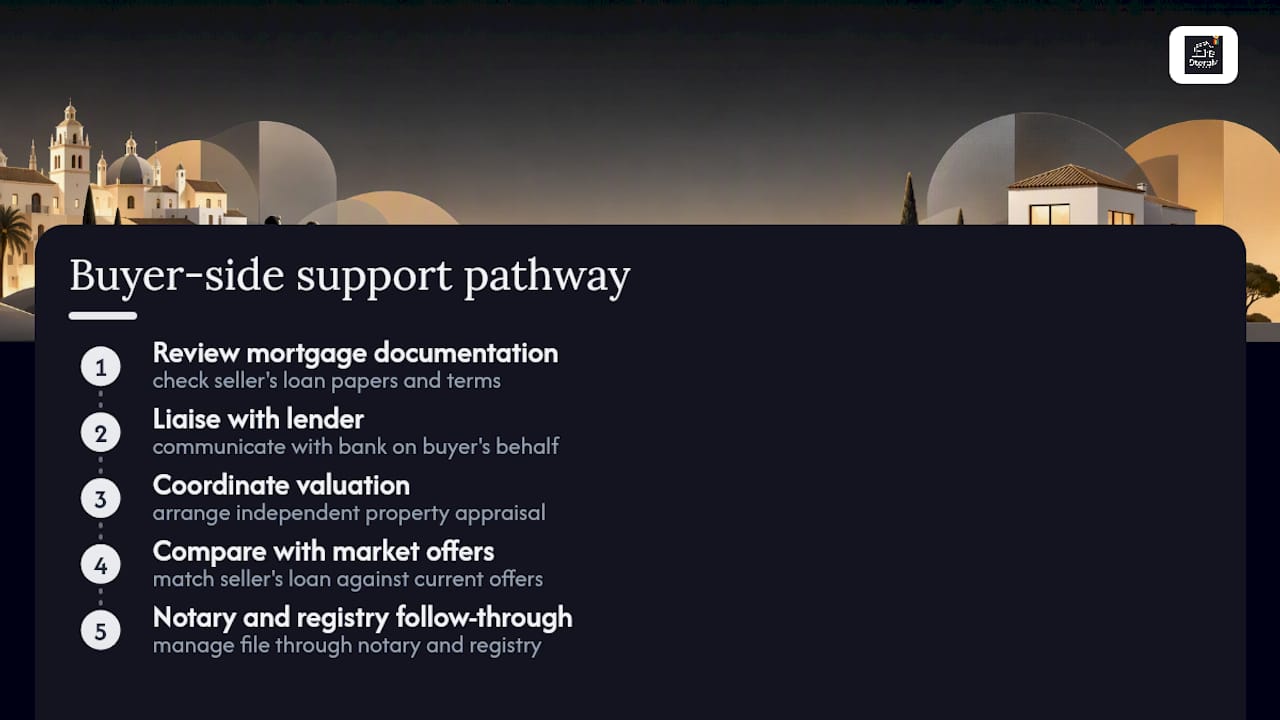
A real estate agency can review the seller’s mortgage documentation, liaise with the lender on your behalf, coordinate the independent valuation, and follow the file through notary and registry. That means someone is comparing the seller’s existing loan against current market offers on your side of the table, not the bank’s.
Get a Financing Check Before You Commit to a Subrogation
Comparing a seller’s existing mortgage against fresh offers takes real digging into commission structures, linked products, and registry timing. That’s exactly the friction point where a property agency earns its fee instead of just collecting one.

A financing check from SteraM Flats includes a review of the seller’s mortgage file, independent guidance on the valuation, and direct contact with lenders to see whether subrogation or a new mortgage actually costs less for your situation. We compare the seller’s loan against current market offers without steering you toward whichever option pays us more, because our role here is the same guide role we play throughout a purchase, from first offer to notary signing. Have your NIE, income documents, and the seller’s mortgage deed reference ready, then reach out to start the file review.
Sources
For legal wording on bank procedures, the Portal del Cliente Bancario run by Banco de España is the primary source. For dispute resolution if a bank misses its deadlines, the FIN-NET network outlines your complaint routes.
- Subrogación hipoteca: guía para cambiar la hipoteca de banco — Cohispania
- ¿Qué es y cómo hacer una subrogación de hipoteca? — BBVA
- Subrogación o cambio de banco — Portal del Cliente Bancario
- Subrogación hipotecaria en España: Todo lo que deba saber — Welex
FAQ
Who pays the costs of a mortgage subrogation?
In most buyer-seller deals, the buyer taking on the mortgage pays the subrogation commission, the new valuation fee, and the notary and registry costs, though this can be negotiated as part of the purchase price.
What are the requirements to subrogate a mortgage?
You need a clean credit file, proof of income (payslips, tax returns), valid ID or NIE, and you must pass the same lending assessment a new mortgage applicant faces.
When is it worth subrogating a mortgage instead of getting a new one?
It’s usually worth it when the existing interest rate beats current market offers and the subrogation commission plus valuation fee costs less than a new mortgage’s setup fees and tax.
How much does it cost to subrogate a mortgage to another person?
Costs vary by bank and loan size, but they typically include the subrogación de deudor commission, a new tasación, and notary and registry fees, generally landing well below the cost of opening a fresh mortgage from zero.
What happens if the bank refuses the subrogation?
The seller must cancel the existing mortgage so the property transfers free of charges, and the buyer then arranges independent financing through a new mortgage application.