
Technical advice in real estate is the independent, expert-driven process of evaluating properties, assessing risks, and translating physical conditions into financial and contractual decisions. It is not a luxury add-on. For buyers, lenders, and portfolio managers, it is the mechanism that separates informed capital deployment from expensive guesswork. At its core, technical advisory covers independent due diligence, risk categorization, capital expenditure (CAPEX) mapping, and ongoing performance monitoring across the full lifecycle of an asset.
The practical function goes further than most people expect. A technical advisor does not just flag problems. They convert findings into negotiation leverage, contractual safeguards, and cash flow projections that directly affect deal structure and returns. Lenders and developers engage independent advisors at critical project stages to verify feasibility and monitor performance, protecting capital before and after a financial commitment is made. The National Association of Realtors (NAR) and broader industry practice both recognize independent technical assessment as a foundational risk management tool, particularly as projects grow in complexity and regulatory exposure.
- Technical due diligence covers structural integrity, building envelope, MEP systems (mechanical, electrical, plumbing), code compliance, and energy efficiency.
- CAPEX mapping categorizes costs by urgency: immediate (0–24 months), medium-cycle (3–5 years), and strategic (repositioning or change of use).
- Risk assessment translates each finding into probability and financial impact, feeding directly into underwriting models and negotiation strategy.
- Ongoing monitoring tracks asset performance against baselines, flagging deviations before they become overruns.
Table of Contents
- How do real estate consultants differ from agents and brokers?
- What core services do technical advisors actually provide?
- Who actually benefits from engaging technical advice?
- How does a real estate consulting engagement actually work?
- What do real estate consultants charge, and how does the fee model affect objectivity?
- How do you choose the right real estate consultant or technical advisor?
- What are the real benefits of technical advice in real estate?
- How is the role of technical advice in real estate evolving?
- What technical disciplines are involved in real estate advice?
- When is technical advice most critical in a real estate transaction?
- What are the real limitations of relying on technical advice?
- How technical advice changes real outcomes: real-world examples
- Steramflats brings technical advisory expertise to your real estate decisions
- Key Takeaways
How do real estate consultants differ from agents and brokers?
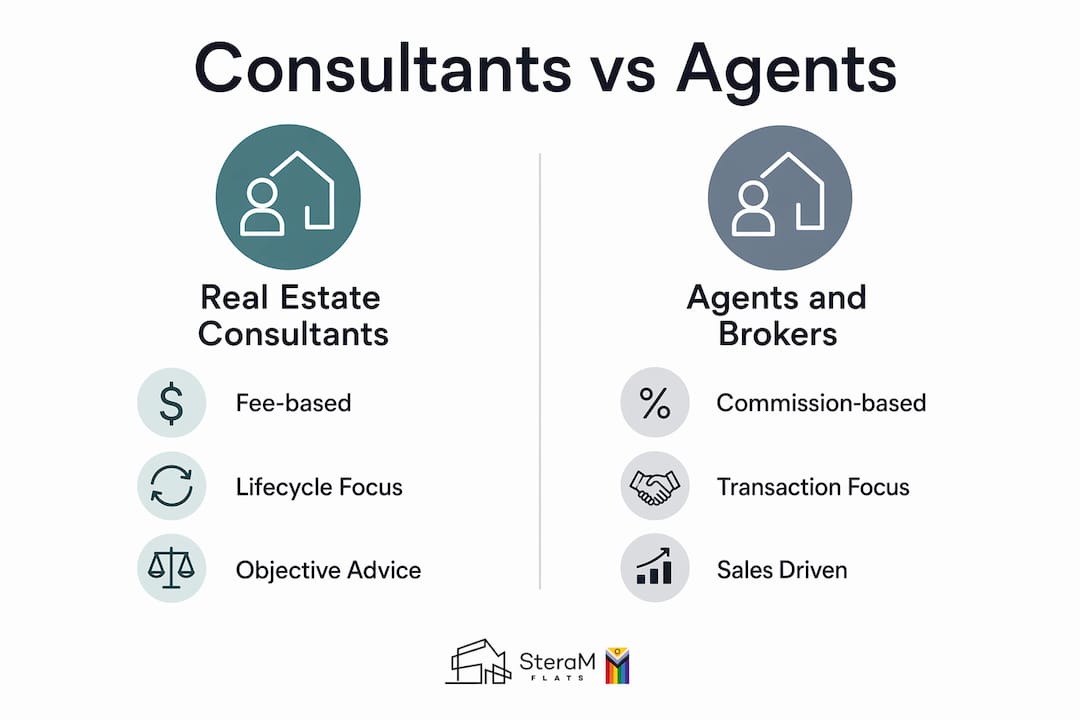
The distinction matters most when you are making a decision that carries real financial risk. Agents and brokers are transaction-focused professionals compensated by commission, which means their incentive is tied to closing a deal. A real estate consultant operates as a fee-based, independent advisor whose compensation is not contingent on whether a transaction closes. That structural difference shapes everything from the advice they give to the risks they are willing to name out loud.
Consultants own the business case across the full lifecycle of an asset, from initial analysis through delivery and repositioning. They complement brokers and project managers by managing cross-functional plans that span capital, design, and operations. Where a broker executes a transaction within a plan, a consultant builds and stress-tests the plan itself.
| Function | Real estate consultant | Agent or broker |
|---|---|---|
| Compensation model | Fee-based (flat, hourly, retainer) | Commission on transaction |
| Primary incentive | Client outcome and risk management | Transaction completion |
| Scope of work | Strategy, due diligence, portfolio management | Listing, marketing, negotiation |
| Independence | Fully independent, no deal-closing pressure | Tied to transaction success |
| Client relationship | Long-term advisory, ongoing monitoring | Transaction-specific |
| Risk identification | Proactive, detailed risk categorization | Limited to deal facilitation |
For a decision-maker seeking objective technical guidance, that independence is the point. An advisor who earns more when you buy is not positioned to tell you not to buy.
What core services do technical advisors actually provide?
Technical advisory spans the full transaction and asset management cycle, not just the pre-purchase inspection. The depth of each service scales with asset size and complexity, but certain functions appear in nearly every engagement.
- Technical due diligence: Structural assessment (load-bearing capacity, cracks, damp, corrosion), building envelope review (roof, facades, thermal bridges), and MEP system evaluation covering regulatory compliance, obsolescence, and replacement costs.
- Feasibility studies and market analysis: Demand studies, comparable analysis, absorption projections, and program optimization that produce a go/no-go recommendation with supporting quantitative analysis.
- CAPEX mapping: Classification of capital needs by time horizon, feeding directly into financial models and negotiation strategy. Without this, projected returns are unreliable.
- Contractual and financial advisory: Translating technical findings into price adjustments, holdbacks, conditions precedent, and milestone payment schedules that protect cash flow at closing.
- Portfolio optimization: Hold/sell analysis, asset repositioning, debt options, and performance monitoring across multiple assets and markets.
- Data and analytics integration: Scenario modeling across variables like construction cost escalation, market absorption curves, and power availability ranges, giving clients sensitivity analysis rather than a single point estimate.
Real estate expert reports extend this further, covering legal, financial, regulatory, and technical assessments that can support court proceedings, insurance claims, and inheritance disputes. The report is not the end product. The decisions it enables are.
Who actually benefits from engaging technical advice?
The short answer is: anyone with capital at risk in a property decision. The longer answer involves understanding which specific challenges each type of client faces and how technical advice addresses them directly.

Private investors and family offices use technical advisors to get objective risk profiles before committing capital, particularly when acquiring assets with deferred maintenance or repositioning potential. They need someone who will tell them what the asset actually costs to own, not just what it costs to buy.
Lenders occupy a different position. They require independent verification of project feasibility and draw validations at two critical junctures: before a financial investment decision and during construction when borrowers request funding draws. An advisor without hands-on construction execution experience can miss delivery risks that a design-focused specialist would never catch, creating dangerous blind spots precisely where financial exposure is highest.
Property owners and occupiers benefit from ongoing technical monitoring that tracks compliance, energy performance, and maintenance needs against defined baselines. Developers and institutional teams rely on advisors to navigate complex regulatory environments, manage entitlement processes, and coordinate third-party specialists across environmental, geotechnical, and structural disciplines.
Pro Tip: If you are a first-time investor entering a new market, a technical advisor functions as a force multiplier. They compress the learning curve on local regulatory nuance and asset condition in ways that no amount of market research replaces.
How does a real estate consulting engagement actually work?
The process is more structured than most clients expect, and that structure is what makes the output usable rather than decorative. A technical report that cannot be tied to a specific clause or a CAPEX line is, as one advisor put it, just a well-formatted PDF.
- Scope definition: Before visiting the asset, the advisor and client align on the precise questions the engagement must answer. Is this a go/no-go feasibility? A pre-closing risk assessment? A portfolio rebalancing analysis? Clarity here determines everything from methodology to deliverable format.
- Site inspection and document review: Visual inspection, measurements, photographic documentation, and review of building logbooks, permits, certificates, maintenance contracts, and incident records. Lab tests or specialist assessments are added where visible findings warrant them.
- Risk categorization and CAPEX mapping: Each finding is assessed for probability and financial impact, then mapped to a CAPEX line with cost ranges and timelines. This feeds the financial model and the negotiation strategy simultaneously.
- Reporting: The deliverable separates the executive summary (figures, findings, recommendations) from the technical annexes (photos, test results, supporting documentation). Decision-makers get what they need without wading through appendices; operational teams get the detail they need to act.
- Negotiation support: Technical findings become contractual tools — price adjustments, holdbacks, retention guarantees, conditions precedent tied to licensing or test results, and milestone payment schedules aligned with construction progress.
- Ongoing monitoring: Post-closing, advisors track performance against the agreed baseline, flagging deviations in cost, schedule, or compliance before they compound.
The closing schedule alignment piece is often underestimated. When technical milestones (design approval, construction commencement, commissioning) are tied to payment triggers, the advisor’s role extends well past the transaction date.
What do real estate consultants charge, and how does the fee model affect objectivity?
Fee structure and objectivity are directly connected. A consultant paid by commission has a financial stake in the outcome of the transaction. A fee-based consultant does not. That difference is not subtle when the advice involves recommending against a deal.

Technical consultant compensation generally follows three structures: flat fees for defined-scope engagements (a single due diligence report, a feasibility study), hourly rates for advisory work with variable scope, and retainers for ongoing portfolio monitoring or long-term advisory relationships. Each model has its place depending on the engagement type and client need.
Factors that drive fee levels include asset complexity, geographic scope, the number of disciplines involved (structural, MEP, environmental, legal), and the depth of reporting required. A single-asset residential due diligence engagement costs considerably less than a multi-asset portfolio review with regulatory compliance mapping across jurisdictions.
The transparency benefit of fee-based models is straightforward: the advisor’s financial interest is aligned with delivering accurate, useful analysis, not with closing a deal. For lenders in particular, this independence is not optional. It is the entire basis on which the advisor’s assessment carries weight with credit committees and investment boards.
How do you choose the right real estate consultant or technical advisor?
The wrong advisor can be worse than no advisor. A technically credentialed professional who lacks hands-on execution experience may certify unachievable budgets and schedules, as has happened in documented lender-advisory failures where advisors missed critical delivery risks because their background was limited to design evaluation rather than construction management.
Start with specialization. A consultant with deep experience in commercial office assets may not be the right choice for a mixed-use development with complex entitlement requirements. Match the advisor’s track record to your asset type, transaction structure, and regional market.
Technical reports must be authored by qualified, impartial experts with appropriate local knowledge, legal awareness, and professional accreditation. For any report that may be used in legal proceedings or insurance claims, judicial experience matters. Ask whether the expert has testified before and review anonymized sample reports before engaging.
Key selection criteria:
- Professional accreditation: Registration with the relevant professional body for your jurisdiction and asset type.
- Independence: No financial relationship with the counterparty, the lender, or any party whose interests conflict with yours.
- Methodological clarity: Ask specifically what standards and valuation methods they apply (in the U.S. context, USPAP compliance for appraisers; ASTM standards for environmental assessments; IBC and local codes for structural review).
- Execution experience: For lenders especially, verify that the advisor has managed construction delivery, not just evaluated design documents.
- References and prior work: Request examples of previous engagements with comparable asset types and transaction structures.
For complex projects, a multi-advisor model with complementary expertise across project phases often provides better coverage than a single generalist firm.
What are the real benefits of technical advice in real estate?
The clearest benefit is risk avoidance. Failure to engage independent technical validation at critical stages can expose buyers and lenders to remediation costs ranging from $150,000 to $800,000 per incident. That range reflects the real cost of discovering structural defects, MEP non-compliance, or deferred maintenance after closing rather than before.
Beyond cost avoidance, technical advice improves negotiation outcomes. When findings are mapped to specific CAPEX lines and tied to contractual clauses, buyers can compel vendor remediation, negotiate price reductions, or structure holdbacks that protect cash flow through the early years of ownership. The report becomes a negotiation instrument, not just a risk register.
Portfolio-level benefits accumulate over time. Ongoing technical monitoring updates net operating income (NOI), cash curves, and cash-on-cash returns with accurate CAPEX data, allowing owners to rebalance toward assets that generate the best risk-adjusted returns. Property advisory services that integrate technical and financial analysis give investors a clearer picture of where capital is working and where it is not.
Independent technical reports also carry legal and financial weight beyond the transaction itself. They support insurance claims, provide evidence in court proceedings, and document compliance status in ways that self-reported assessments cannot. The value of that independence compounds every time the report is used.
How is the role of technical advice in real estate evolving?
The most significant shift is happening at the intersection of AI and human judgment. AI-native tools are compressing data gathering timelines in real estate consulting, producing feasibility analyses, site screening reports, and due diligence summaries faster than traditional manual methods. A feasibility study that once took four to six weeks to assemble can now be produced in a fraction of that time.
What AI does not replace is the judgment layer. Whether a site is worth pursuing given a specific risk profile, how a planning department will actually interpret a setback requirement, what a complex joint venture partnership structure means for execution risk — these require practitioners who have lived through projects, not just modeled them. The human role shifts from doing the research to calibrating the model and making the calls that require local knowledge and institutional relationships.
A second evolution involves the integration of disciplines that have historically operated in silos. Finance, development, and operations teams often work from different assumptions and different data. Technical consulting that integrates these functions into a single, coherent business case produces better decisions than any of the three disciplines working independently. This is where experienced consultants add value that no software tool replicates.
The risk of advisors lacking hands-on execution experience is also becoming more visible. As projects grow in complexity, the gap between design evaluation and construction delivery expertise creates blind spots that can result in certified but unachievable project baselines, as documented in lender-advisory cases where construction expertise was absent from the advisory team.
Pro Tip: Use the technical due diligence report as a living negotiation document, not a one-time deliverable. Tie each CAPEX finding to a specific contractual clause before closing, and revisit the report at each major project milestone to verify that vendor commitments are being met.
For investors exploring feasibility analysis as part of early-stage development decisions, the same principle applies: the analysis is only as useful as the decisions it enables.
What technical disciplines are involved in real estate advice?
Real estate advisory draws on a cluster of specialized disciplines, each addressing a different dimension of asset risk and value. No single advisor covers all of them at depth, which is why complex transactions often involve coordinated teams.
Structural engineering assesses load-bearing capacity, pathologies (cracks, settlement, corrosion), and expected useful life. A structural finding that changes the asset’s useful life changes its valuation, its financing terms, and its repositioning potential simultaneously.
Building envelope and MEP systems cover the roof, facades, thermal bridges, HVAC, electrical, plumbing, sanitation, fire safety, and vertical transportation. A non-compliant or obsolete MEP installation can derail a releasing plan entirely, particularly in assets targeting institutional tenants with specific operational requirements.
Valuation goes beyond comparable sales analysis. Independent appraisers apply methods including the income approach (capitalizing net operating income), the cost approach (replacement cost minus depreciation), and the residual method for development land. USPAP standards govern appraisal practice in the United States, and lenders require USPAP-compliant reports for most financing decisions.
Environmental assessment covers Phase I and Phase II site assessments under ASTM standards, identifying recognized environmental conditions (RECs) that could affect title, financing, or remediation liability.
Legal and regulatory compliance maps the asset against current zoning, building codes, fire safety requirements, accessibility standards (ADA compliance in the U.S.), and permit status. An asset with “minor” non-conformities may require mandatory works that materially change projected returns.
Energy efficiency and sustainability analysis identifies opportunities in building envelope and systems, quantifying return on investment through reduced operating costs, increased occupancy, or improved asset classification. This discipline is growing in importance as energy performance increasingly affects both financing terms and tenant demand.
When is technical advice most critical in a real estate transaction?
Technical advice is not uniformly valuable across a transaction timeline. It concentrates at specific decision points where the cost of missing information is highest.
Pre-purchase inspection and due diligence is the most widely recognized stage. Before committing to acquisition, buyers need an independent assessment of the asset’s physical condition, compliance status, and CAPEX requirements. This is where the majority of risk is either identified and priced into the deal or missed and absorbed post-closing.
Feasibility studies come earlier, at the point where a developer or investor is evaluating whether a site, program, and market support a viable project. The output is a go/no-go recommendation with quantitative support. Quality varies significantly depending on the analyst’s data access and market knowledge, which is why professional feasibility analysis matters when capital is at stake.
Financing and draw validation is critical for lenders. Independent advisors verify that project progress matches borrower representations before approving funding draws. Without this, lenders are relying on self-reported data from parties with a direct financial interest in the draw being approved.
Repositioning and value-add planning requires technical input to distinguish between maintenance CAPEX (restoring standard) and strategic CAPEX (lifting rent, occupancy, or enabling a change of use). Mixing the two inflates projected returns in financial models while understating real cash requirements in the early years.
Ongoing asset management uses technical monitoring to track compliance, energy performance, and maintenance against defined baselines. The key performance indicators here include CAPEX backlog, compliance index (accessibility, fire safety, permits), mean time to resolve critical issues, and baseline energy consumption.
What are the real limitations of relying on technical advice?
Technical advice is not infallible, and understanding its limitations helps you use it more effectively rather than treating reports as definitive verdicts.
Scope limitations are the most common source of missed risk. A visual inspection does not reveal what is behind walls, under floors, or within sealed systems. Advisors can only assess what they can observe, test, or document. Hidden defects that fall outside the agreed inspection scope remain the buyer’s risk unless specific testing is commissioned.
Advisor experience gaps create real exposure. As documented in lender-advisory cases, a technically credentialed professional without hands-on construction delivery experience may evaluate design documents accurately while missing the execution risks that materialize during procurement, logistics, and construction. Credentials alone do not guarantee the right expertise for a specific project phase.
Report currency is another practical constraint. A due diligence report reflects the asset’s condition at a specific point in time. In a fast-moving market or a project with active construction, conditions can change materially between the report date and closing. Advisors should be re-engaged if significant time passes or if material changes occur.
Cost and time requirements are real factors for smaller transactions. A thorough technical due diligence engagement takes time and costs money. For lower-value assets, the proportional cost of a full advisory engagement may not be justified, though the risk of skipping it is often underestimated.
Interpretation variability means that two qualified advisors reviewing the same asset may reach different conclusions about risk severity or CAPEX magnitude. This is not a failure of the process. It reflects the judgment-intensive nature of technical assessment and underscores the importance of selecting advisors with directly relevant experience rather than general credentials.
How technical advice changes real outcomes: real-world examples
The clearest illustration of what technical advice does in practice comes from situations where it was either applied effectively or absent when it was needed.
In a documented lender advisory case, a technical advisor with strong mining sector experience but limited construction expertise certified unachievable budgets and schedules for an underperforming project in Latin America. Progress was materially overstated, and remaining costs and schedule were grossly understated. The project was unable to secure additional funding, resulting in a near-total loss to lenders. The gap was not in the advisor’s technical knowledge of the asset type. It was in their inability to identify construction delivery risks that an experienced project delivery professional would have caught early.
On the acquisition side, consider a commercial real estate investor evaluating a mixed-use asset with deferred MEP maintenance and partial fire compliance gaps. A technical due diligence engagement identifies the compliance deficiencies and maps them to a CAPEX requirement with a defined remediation timeline. The buyer uses the findings to negotiate a price reduction covering the immediate CAPEX, a holdback tied to completion of fire safety works, and a condition precedent requiring the seller to obtain outstanding permits before closing. The deal closes at a price that reflects actual asset condition rather than asking price assumptions.
Portfolio-level impact is less dramatic but equally concrete. An owner tracking a multi-asset portfolio without technical monitoring may carry assets with growing CAPEX backlogs and declining compliance scores without recognizing the drag on returns. Introducing systematic technical monitoring, with defined KPIs for each asset, allows the owner to identify which properties are consuming capital disproportionately and rebalance toward assets with better risk-adjusted performance. The real estate project management discipline that supports this kind of ongoing oversight is a direct extension of the advisory function.
Steramflats brings technical advisory expertise to your real estate decisions
If you are navigating a property purchase, managing a rental portfolio, or evaluating an investment opportunity in Spain, the gap between a good outcome and a costly one often comes down to the quality of advice you receive before you commit.

Steramflats offers property advisory services that go beyond transaction facilitation. The team covers property valuation, technical assessment, legal documentation, license management, and renovation project coordination, giving investors and buyers a single point of contact for the full advisory process. For clients interested in southern Spain, particularly the Torremolinos area, Steramflats combines local market knowledge with the kind of hands-on technical and legal support that protects your investment from the due diligence stage through ongoing asset management.
Whether you are buying, selling, or building a rental portfolio, the next step is straightforward. List your property or connect with the Steramflats advisory team to get a clear picture of what your asset is worth, what it will cost to manage, and how to structure the transaction to protect your returns.
Key Takeaways
Technical advice in real estate functions as an independent risk management and negotiation tool that protects capital at every stage of a transaction and throughout asset ownership.
| Point | Details |
|---|---|
| Remediation cost exposure | Skipping independent technical validation can expose buyers to remediation costs ranging from $150,000 to $800,000 per incident. |
| CAPEX mapping drives deals | Technical findings tied to CAPEX lines and contractual clauses give buyers concrete negotiation leverage before closing. |
| Advisor experience matters | Lenders need advisors with construction execution experience; design-only expertise misses critical delivery risks. |
| AI accelerates, humans decide | AI compresses data gathering in consulting, but human judgment remains essential for risk interpretation and regulatory nuance. |
| Steramflats advisory support | Steramflats provides property valuation, technical assessment, and legal advisory for investors and buyers in southern Spain. |