
Yes. Under Real Decreto 390/2021, any landlord renting a home to a new tenant in Spain must have a valid certificado energético alquiler before signing the lease, and it has to be registered with the regional organismo competente to count as legally valid. Miss that step and you’re facing fines, not just a nagging compliance gap. A handful of exceptions apply, mostly tiny units under 50 square meters and certain non-habitable spaces, but for the vast majority of rentals, this document is not optional paperwork.
TL;DR:
- A new tenant, property sale, significant renovation, or advertising the rental triggers the obligation to obtain a registered energy certificate, but lease renewals with the same tenant generally do not.
- Only qualified professionals, typically registered architects or engineers, can legally issue a valid energy performance certificate after physically inspecting the property on-site.
- The certificate must be registered with the regional authority to be legally valid, and failure to do so can result in fines up to €6,000.
- Costs for obtaining the certificate typically range between €60 and €150, depending on property size, location, and urgency.
- Including the energy label in listings and providing copies to tenants at signing helps avoid disputes and regulatory penalties.
Table of Contents
- What Real Decreto 390/2021 Requires From Landlords
- Who Handles the Paperwork: Owner Duties and Technician Rules
- Getting Your Certificate: The Step-by-Step Process
- What a Certificate Actually Costs and How to Keep It Reasonable
- Tourist Rentals, Small Units, and Other Exceptions That Confuse Landlords
- Fines for Skipping the Certificate and How to Avoid Them
- Advertising and Handover: What Goes in the Listing and the Lease
- A Landlord’s Practical Checklist for Getting This Right
- Why Compliance Actually Protects Landlords, Not Just Tenants
- Let SteraM Flats Handle the Certification Headache for You
- Sources
What Real Decreto 390/2021 Requires From Landlords
The rule has been in force since June 3, 2021, and it applies whenever a home changes hands through sale or moves to a new tenant through rental. Real Decreto 390/2021 sets the legal trigger squarely on that moment of transaction: no certificate, no lawful new tenancy. The decree replaced an older 2013 framework and tightened enforcement, particularly around tourist accommodation, which had previously slipped through gaps in the old rules.
What actually forces the obligation to kick in:
- Signing a new lease with a tenant who has never occupied that specific unit before
- Selling the property, whether occupied or vacant
- Completing new construction, where the certificate becomes part of the handover documents
- Advertising the property for rent or sale through any channel, print or digital
Here’s the detail that trips up a lot of landlords: renewing an existing lease with the same tenant does not trigger a new obligation. If your tenant signs a fresh one-year contract after their initial term ends, and it’s the same person occupying the same flat, you don’t need a new certificate purely because paperwork got renewed. The regional FAQ guidance on RD 390/2021 confirms this distinction explicitly, and it matters because plenty of property managers assume every contract renewal resets the compliance clock. It doesn’t.
Where the timeline gets murkier is around administrative deadlines tied to specific categories, like tourist rentals, which saw certain compliance windows extend into 2022 as regions adjusted their registries and enforcement mechanisms. If you bought a property in 2021 and it already came with a valid, registered certificate from the seller, you generally don’t need a fresh one just because you’re now the landlord instead of the previous owner, so long as the existing certificate hasn’t expired and covers a full unit, not a fraction of one.
Who Handles the Paperwork: Owner Duties and Technician Rules
The legal responsibility sits with you, the owner, or whoever legally represents you in the transaction, such as a property manager acting under a signed mandate. You commission the certificate, you pay for it, and you’re the one who has to produce it if a tenant, a portal, or a regional inspector asks for proof.
The technician side of this is not flexible. Only qualified professionals, generally architects or engineers registered with their professional body, can legally issue an energy performance certificate. And here’s the part some cut corners on: the technician must physically visit the property. Certificates generated remotely from floor plans or photos, without an on-site inspection, are not valid under Spanish law and expose both the owner and the issuing technician to sanctions.
Once the technician finishes the assessment, three things need to happen in sequence:
- The technician drafts the report and assigns an energy rating from A (most efficient) to G (least efficient)
- You or your representative submit that report to the Comunidad Autónoma’s energy certification registry
- The regional body issues a registration number, and only then is the certificate legally usable in a lease
That registration step is not a formality you can skip. A certificate that was never registered with the regional organismo competente carries no legal weight, even if the technician’s assessment itself was done correctly. You also need to hand the tenant a copy of the label and the accompanying efficiency recommendations at signing, not just leave it filed away in a drawer somewhere.
Pro Tip: Keep the registration receipt and the PDF label together in one folder, digital or physical, labeled with the property address and registration number. If a tenant or inspector ever asks, you want to produce it in under a minute, not dig through email threads from two years ago.
Getting Your Certificate: The Step-by-Step Process
Start by finding a technician registered with your region’s official list, usually accessible through the regional energy or industry department’s website. Most Comunidades Autónomas publish a searchable registry of authorized architects and engineers, and checking that list before you hire anyone saves you from a certificate that gets rejected at registration.
The practical process breaks down into four stages:
- Request quotes from two or three technicians. Prices vary by region and by property size, so a quick comparison protects you from overpaying.
- Schedule the in-person visit. The technician needs access to the whole unit, not just a walkthrough of the living room. Expect them to check windows, insulation, heating and cooling systems, water heaters, and the general envelope of the building.
- Wait for the calculation and report. The technician runs the collected data through certified software that produces the energy rating and a document detailing consumption estimates and improvement suggestions.
- Submit for registration. Either the technician or your representative uploads the report to the regional registry, and you receive a registration number once it’s approved.
What the technician actually inspects during that visit matters more than most landlords realize. They’re looking at wall and roof insulation, the type and condition of windows, the efficiency of the boiler or heat pump, whether there’s mechanical ventilation, and how much natural light the unit gets. All of that feeds into a software calculation that spits out the letter grade you’ll see on the final label.
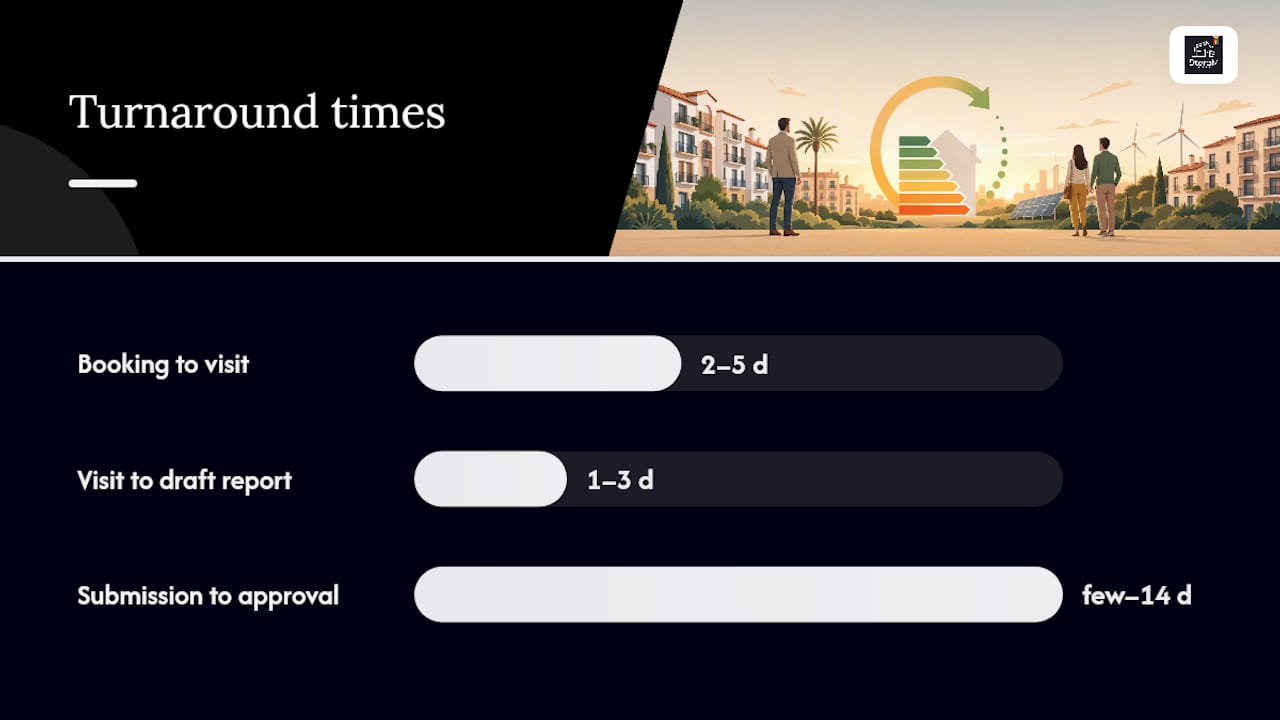
Turnaround times vary, but here’s a rough breakdown of what to expect:
- Booking to visit: Usually 2 to 5 business days in cities, longer in rural areas with fewer registered technicians
- Visit to draft report: Typically 1 to 3 business days
- Submission to registration approval: Anywhere from a few days to two weeks depending on the region’s backlog
Delays usually come down to two things: a technician juggling too many jobs during peak rental season, or a regional registry with a slow processing queue. Coastal provinces with heavy tourist rental turnover, unsurprisingly, tend to have longer waits in spring and early summer. If you know you’re renting out a property for the season, book your technician visit at least three weeks ahead of when you plan to list it.
What a Certificate Actually Costs and How to Keep It Reasonable
Prices for a residential certificado energético typically fall between €45 and €150, with the final number driven mostly by property size, location, and how quickly you need it. A studio in a smaller town usually lands on the low end. A large multi-bedroom home in a major city, especially one needing a rush turnaround, pushes toward the higher figure.
The math that matters: For most standard rental apartments, expect to pay somewhere in the €60 to €150 range, with the technician’s travel distance and the complexity of the building often accounting for the swing.
Timing from visit to registered certificate generally runs one to three weeks, though regional backlogs can stretch that during peak rental months.
A few things drive the price up or down:
- Property size — larger units take longer to inspect and cost more
- Location — technicians in remote areas may charge a travel premium
- Urgency — same-week turnaround often carries a rush fee
- Building age and complexity — older buildings with irregular layouts take more time to assess
One point worth stating plainly: the cost is legally the owner’s responsibility, not the tenant’s. You cannot fold this fee into a “deposit” or bill it separately to whoever signs the lease. If you’re managing several units, getting quotes from the same technician for multiple properties in one visit often knocks the per-unit price down, since travel and setup time get shared across jobs.
Tourist Rentals, Small Units, and Other Exceptions That Confuse Landlords
Not every rental needs a certificate, but the exceptions are narrower than most owners assume, and getting this wrong is one of the most common compliance mistakes landlords make.
Properties under 50 square meters used as habitable dwellings can, in specific cases, fall outside the strict obligation, along with certain non-habitable spaces like storage rooms, garages rented separately, or buildings slated for demolition. But these carve-outs are narrow, and they don’t apply just because a unit feels small or informal to you. If it’s advertised and rented as a place to live, assume the obligation applies unless you’ve confirmed otherwise with your regional registry.
Tourist rentals deserve their own callout because the rules shifted meaningfully. Vacation apartments used to enjoy something close to a blanket exclusion from certification requirements. That’s no longer the case. Since the 2021 reform and its administrative rollout, tourist rentals generally must display the energy label and hold a valid certificate where the rules apply, with some regions extending compliance deadlines into 2022 while their registries caught up.
Two more scenarios worth flagging:
- Renovation work. A significant renovation, especially one touching insulation, windows, or the heating system, can force a new certificate even if you have a valid one already, because the building’s efficiency profile has changed.
- Same tenant, new contract. As covered earlier, renewing a lease with an existing occupant doesn’t reset the requirement, but switching to a different tenant absolutely does.
When in doubt on a borderline case, a quick call to your region’s energy certification office beats guessing. The consequences of getting it wrong land squarely on you as the owner.
Fines for Skipping the Certificate and How to Avoid Them
Regional authorities enforce this, and the penalties are real. Reported sanctions for noncompliance range roughly from €300 to €6,000, depending on the severity of the infraction and whether it’s a first offense or a repeated pattern.
The infractions that trigger fines most often are mundane, which is exactly why they’re worth double-checking:
- Advertising a rental without showing the energy rating in the listing
- Letting a certificate expire and continuing to rent without renewing it
- Having a certificate that was never registered with the regional authority, even if the technician did a proper inspection
- Handing over a certificate to the tenant late, or not at all, at signing
The certificate isn’t just a bureaucratic hoop. It exists to give tenants a realistic sense of what their energy bills will look like, and displaying the rating honestly in your ads heads off disputes before they start. A tenant who moves into a G-rated flat expecting A-rated heating costs has a legitimate grievance, and that kind of friction is avoidable.
Pro Tip: Save a screenshot or PDF export of your listing at the moment you published it, showing the energy label displayed. If a dispute ever comes up, that timestamped proof is worth more than your memory of what the ad said.
Advertising and Handover: What Goes in the Listing and the Lease
Every listing, whether it’s on a property portal, a printed flyer, or a social media post, needs the energy rating letter visible in the text or image, not buried in an attached PDF nobody opens.
At contract signing, hand your tenant:
- A copy of the registered energy certificate, label included
- The efficiency recommendations report the technician generated alongside the rating
- Proof of the registration number, so the tenant can verify it’s legitimate if they choose to
For your own records, keep this organized in one place:
- The original PDF certificate with the visible label
- The regional registration confirmation or receipt
- A note of the technician’s name and professional registration number
This setup takes ten minutes to organize but saves you real headaches if a tenant, portal, or inspector ever asks for documentation on short notice.
A Landlord’s Practical Checklist for Getting This Right
Here’s a compact sequence you can actually follow instead of hunting through legal text every time you rent out a unit:
- Confirm whether the new tenant triggers the obligation (new tenant, yes; lease renewal with the same tenant, generally no)
- Check your Comunidad Autónoma’s registered technician list before booking anyone
- Schedule the in-person visit at least three weeks before you plan to list the property
- Collect the report, label, and registration number once the technician finishes
- Add the energy rating to your listing before publishing it anywhere
- Hand the tenant a physical or digital copy of the certificate and recommendations at signing
- File the registration receipt and PDF label together, with the property address on both
If you’re managing multiple properties, or you’d simply rather not chase technicians and registries yourself, SteraM Flats’ rental management checklist walks through document handling and compliance steps in more depth, and our team coordinates directly with certified technicians on behalf of owners who’d rather hand off the logistics.
Pro Tip: If you own more than one rental unit, batch your certificate renewals. Booking two or three properties for the same technician visit window often reduces per-unit cost and keeps your paperwork on a predictable schedule instead of scattered across the calendar.
Why Compliance Actually Protects Landlords, Not Just Tenants
We’ve walked plenty of property owners through this process, and the pattern is consistent: the landlords who treat the certificate as a box to tick at the last minute are the ones who end up scrambling before a listing deadline or facing an awkward conversation with a tenant who spotted the missing label. Compliance here isn’t really about fear of fines. It’s about having a paper trail that protects you if a dispute ever surfaces, and giving tenants an honest picture of what they’re signing up for. If you want help getting your documentation in order, SteraM Flats is a good place to start that conversation.
— YellowRock
Let SteraM Flats Handle the Certification Headache for You
Chasing down a registered technician, tracking a regional registry’s processing queue, and making sure your listing displays the right label correctly can be time-consuming. Some services coordinate the parts landlords find most tedious: lining up a qualified technician, keeping your documentation organized, and ensuring your listing meets disclosure rules before it goes live.

Our team supports owners with residential and holiday rentals across southern Spain, including the compliance checks that trip up first-time landlords most often, like matching your certificate’s registration to your actual listing before a portal flags it. You’re always free to use any certified technician and registration route you prefer. If you’d rather have someone else manage the coordination and paperwork end to end, our rental management checklist for landlords is the practical next step, and if your property is a holiday rental specifically, our vacation rental services page covers the added layers of compliance that tourist units carry. Reach out and tell us where your property stands today, and we’ll help you figure out what’s left to do.
Sources
For the primary legal text, see Real Decreto 390/2021 published by MITECO. For registration procedure questions specific to your region, consult your Comunidad Autónoma’s official FAQ guidance on the decree’s practical application.
- Real Decreto 390/2021
- FAQ RD 390/2021 (regional FAQ document)
- Certificado energético para alquilar: obligaciones del arrendador
- Idealista: The energy certificate is mandatory for holiday rentals