Yes, a pareja de hecho can get a mortgage in Spain, but your legal protections differ from marriage and depend heavily on registration and written agreements. Before you approach a lender, decide whether you want a joint or single mortgage, register your union with the relevant regional registry, and put your agreed ownership shares in a notarized deed.
TL;DR:
- Ownership shares are fixed in a notarized deed based on contributions, which should be agreed upon and documented before signing the property deed.
- Registering the property in the Land Registry promptly is crucial, as delays can leave ownership unenforceable against third-party claims.
- A notarized pacto de convivencia detailing ownership, contributions, buyout terms, and exit rules offers stronger protection than a private agreement.
- When separation occurs, the property is typically split through an extinción de condominio, and inheritance rights usually rely on wills due to regional variability.
Table of Contents
- Can a pareja de hecho get a mortgage from a Spanish bank?
- Who owns the property: recording shares in the escritura and the Land Registry
- What to put in your pacto de convivencia before you sign
- What happens to the mortgage and the home after separation or death
- Applying for a mortgage as a pareja de hecho: documents and timeline
- Costs and taxes to budget for as a couple
- How SteraM Flats supports parejas de hecho through the mortgage process
- The gap conventional advice keeps missing
- Sources
- FAQ
Can a pareja de hecho get a mortgage from a Spanish bank?
Spanish banks lend to unmarried couples routinely, and in practice they often prefer joint applications because combined income and joint liability lower the perceived risk. When both partners sign as borrowers, each becomes responsible for the full debt, not just their share, which gives the lender two incomes to fall back on if one partner’s earnings drop.
Some couples choose a different structure: one partner takes the mortgage as sole borrower while both appear as owners on the property title, a setup known as proindiviso. This is more common than people assume. Press coverage on Spanish mortgage practice notes that around a third of mortgage applications are requested by a single person even when the property will belong to more than one owner, and banks generally accept the arrangement, though it changes who carries the debt and who can later use that mortgage history to qualify for new credit.

For non-resident buyers, or couples where one partner lacks Spanish tax residency, lenders tend to be more conservative. Loan-to-value ratios for second homes typically run lower than for primary residences, and SteraM Flats’ experience with financing for non-resident buyers points to a common range of 60% to 75% of the property’s value, meaning the couple needs a larger deposit up front.
A few practical distinctions matter when you’re choosing between joint and single applications:
- Joint mortgage: both incomes count toward approval, but both partners are liable for the full debt regardless of their ownership share.
- Single borrower, joint owners: the non-borrowing partner avoids direct liability to the bank, but may find it harder to build independent credit history.
- Non-resident applications: expect stricter income documentation and lower loan-to-value ratios, especially for second homes.
Pro Tip: If one partner has stronger, more stable income, ask the bank whether adding the other as a co-owner without co-signing the mortgage changes the approved amount before you commit to a structure.
Who owns the property: recording shares in the escritura and the Land Registry
The mortgage and the ownership title are two separate legal documents, and confusing them causes real problems later. Signing a mortgage as sole borrower does not make you sole owner, and being listed as an owner does not automatically make you liable for the debt. What determines ownership is the escritura de compraventa, the deed signed before a notary, and its inscription in the Registro de la Propiedad.
Within that deed, each partner’s cuota de participación, their percentage share of the property, gets fixed at signing. Couples often assume this must be 50/50, but it doesn’t have to be. A share can reflect unequal contributions to the deposit, unequal ongoing mortgage payments, or money one partner put into renovations before or after purchase, provided there is documentation to support the split.
The practical sequence looks like this:
- Agree on the ownership percentage before the notary appointment, based on documented contributions to the deposit and expected mortgage payments.
- Bring proof of each contribution (bank transfers, savings statements) so the notary can reflect an unequal split accurately in the escritura.
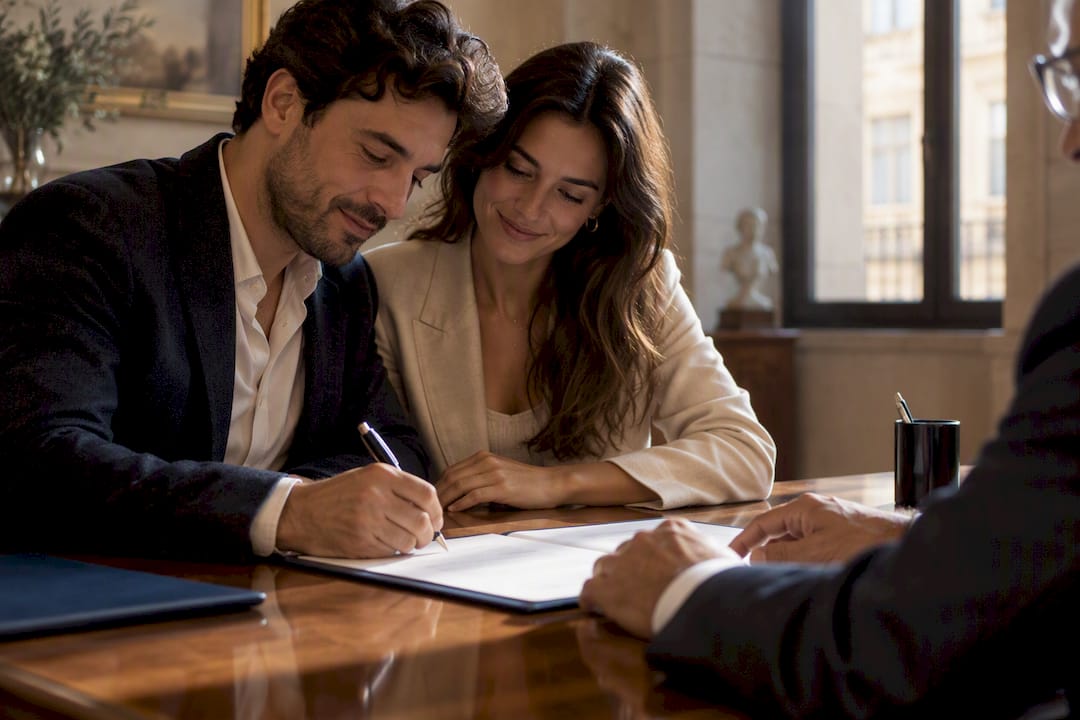
- Sign the escritura de compraventa, which fixes the cuota de participación for each owner.
- Register the deed at the Registro de la Propiedad, ideally soon after signing, since the property isn’t fully protected against third-party claims until it’s inscribed.
- Keep copies of the registered deed and the notary’s certification, since these become the primary evidence of ownership if a dispute arises later.
Registration timing matters more than most buyers realize. Delays in inscription can leave a gap where your ownership isn’t fully enforceable against other claims on the property, so treat registration as part of closing, not an afterthought.
What to put in your pacto de convivencia before you sign
A pareja de hecho lacks many of the automatic protections that marriage provides, which is exactly why a written cohabitation and co-ownership agreement matters more for unmarried couples than for married ones. Lawyers interviewed by La Vanguardia on unmarried couples buying property recommend putting three things in writing before the purchase closes: the ownership percentage, each partner’s contribution to the purchase and ongoing costs, and clear rules for what happens if the relationship ends.
A solid pacto de copropiedad typically covers:
- The exact ownership percentage and how it was calculated.
- Each partner’s share of the deposit, monthly mortgage payments, and running costs like community fees and insurance.
- A buyout formula for one partner to purchase the other’s share, often the current market valuation minus the outstanding mortgage balance.
- A timeline for completing a buyout once one partner requests it.
- Clauses recognizing mortgage payments made by one partner as credit toward that partner’s eventual share, so uneven payments over time are reflected fairly.
- Rules for what happens if one partner stops paying their portion of the mortgage.
Putting this in a private contract is better than nothing, but a public deed carries far more weight if a dispute reaches court. Notarizing the pacto de convivencia gives it evidentiary strength that a signed piece of paper between partners doesn’t have on its own.
Pro Tip: Bring a draft buyout formula and a proposed right-of-first-refusal clause to your first notary or lawyer meeting rather than starting from a blank page. It speeds up the conversation and forces you to agree on the hard numbers early.
What happens to the mortgage and the home after separation or death
When a pareja de hecho separates, the property doesn’t split itself. If both partners are registered owners, the usual route is an escritura de extinción de condominio, where one partner keeps the property and compensates the other for their share. Notary guidance on ending co-ownership after a break-up explains that the compensation is usually adjusted to account for the outstanding mortgage balance still attached to the property, so the departing partner isn’t paid as if the debt didn’t exist.
Inheritance is where the gap with marriage is widest. Spanish inheritance law does not automatically grant a pareja de hecho the same rights a spouse has, and what protections do exist vary by autonomous community and depend on registration with the local pareja de hecho registry. Because rules and registration requirements differ by region, a partner who wants the other to inherit their share of the home generally needs a will that says so explicitly, rather than relying on default succession rules.
When a mortgage is still outstanding at separation, the couple typically has three paths:
- Subrogation: one partner takes over the full mortgage and buys out the other’s share, often renegotiating terms with the same lender.
- Refinancing: the remaining owner applies for a new mortgage sized to their own income, paying off the joint loan.
- Sale and split: the property is sold, the mortgage is settled from the proceeds, and the remainder is divided according to each partner’s registered ownership share.
Applying for a mortgage as a pareja de hecho: documents and timeline
Spanish lenders assess a pareja de hecho largely the same way they assess any joint application, but a few documents are specific to your legal status. Expect to gather DNI or NIE for each partner, empadronamiento (proof of registered address), proof of the pareja de hecho itself (either a certificate from the regional registry or a public deed confirming the union), recent payslips, tax returns, and evidence of the deposit funds.
The typical process runs as follows:
- Get a pre-approval based on both incomes (or one income, if applying as sole borrower) and existing debt obligations.
- Submit full documentation, including proof of pareja de hecho registration and empadronamiento for both partners.
- Wait for the bank’s solvency assessment, which reviews income stability, existing debts, and often requires linked products like home insurance or life insurance as a condition of approval.
- Receive the binding mortgage offer (oferta vinculante), which under national credit disclosure rules must list known fees and clearly describe the amortization schedule.
- Sign the escritura before a notary, at which point the mortgage and the ownership shares are formalized together.
- Register the deed and mortgage at the Registro de la Propiedad.
Registration at the Land Registry commonly takes around 15 business days once the escritura is submitted, though delays can stretch that window if documentation is incomplete. If you’re refinancing an existing mortgage through subrogation, or closing out a paid mortgage through cancelación registral, budget similar processing time and confirm with your bank which steps they handle directly versus which fall to you.
Costs and taxes to budget for as a couple
Buying with a pareja de hecho involves the same one-time and recurring costs any buyer faces in Spain, but splitting them fairly between partners needs to be settled before closing, not after. One-time costs include notary fees for the escritura, Registro de la Propiedad inscription fees, the mortgage registration tax, and either transfer tax or VAT depending on whether the property is new or resale, both of which vary by autonomous community.
Recurring costs to plan for jointly:
- Mortgage interest and principal, split according to your agreed contribution percentages.
- Community fees (comunidad) if the property is part of a building or urbanization.
- IBI, the annual local property tax.
- Home insurance, often required by the lender as a linked product.
- Any other linked products the bank requires as a condition of the mortgage, such as life insurance.
Under Spanish credit disclosure rules, lenders must clearly state which fees are known at signing and which remain estimates, and the TAE (annual equivalent rate) should reflect linked product costs. Ask your bank directly which fees in your offer are fixed and which could change, and get that answer in writing before you sign.
How SteraM Flats supports parejas de hecho through the mortgage process
Two situations come up often for unmarried couples buying property: wanting a better mortgage offer than the one currently on the table, and needing to close out a mortgage cleanly when a property sells or a partner buys out the other. SteraM Flats’ mortgage subrogation service helps couples renegotiate or transfer a mortgage to more favorable terms, which is useful both for improving an existing offer and for the subrogation step after a separation. When a mortgage is fully paid off or needs to be removed from the property record, cancelación registral de hipoteca clears that debt from the Land Registry so the title is unencumbered for a sale or refinance.
Beyond the mortgage itself, the agency coordinates the paperwork that tends to trip couples up: scheduling notary appointments, helping structure a pacto de convivencia or copropiedad with the right clauses, and advising non-resident partners on the documentation Spanish lenders expect.
- Ask what evidence the agency can provide of past subrogation cases and typical turnaround times before you commit.
- Request a written breakdown of which services are commission-based and which carry a separate fee.
- Confirm which lender documentation requirements apply specifically to your residency status.
Pro Tip: If you’re unsure whether subrogation or a fresh mortgage application makes more sense for your situation, ask for a comparison of both routes in writing before choosing either.
The gap conventional advice keeps missing
Most guidance on this topic treats the mortgage as the hard part and the paperwork around it as an afterthought. That’s backwards. Getting a bank to say yes to a pareja de hecho is rarely the obstacle. The real risk sits in what happens years later, when the relationship ends or one partner dies, and the couple discovers that being unmarried means none of the protections they assumed were automatic actually apply.
The conventional fix, “just get a lawyer eventually,” undersells how time-sensitive this is. Ownership shares, buyout formulas, and inheritance intentions need to be settled before the escritura is signed, not renegotiated under pressure during a breakup. A notarized pacto de convivencia costs little relative to the property itself and does more to protect both partners than any amount of comparison shopping between mortgage rates.
If you take one thing from this, prioritize the paperwork that has no automatic substitute: register your pareja de hecho where required, write your ownership shares into a public deed, and put your exit terms in writing before you need them.
— YellowRock
This article is general information, not a substitute for advice from a qualified financial advisor. Consult a qualified financial professional about your own circumstances before acting on anything here.
Sources
For legal confirmation beyond this guide, the Consejo General del Notariado’s Q&A and the government’s own guidance on parejas de hecho are the two most reliable starting points, alongside national credit disclosure rules for anything mortgage-specific.
- ¿Cómo puedo quedarme con la parte de la vivienda que es de mi ex pareja? – Notariado
- Me voy a comprar un piso con mi pareja y no estamos casados: las 3 cláusulas que los abogados recomiendan dejar por escrito – La Vanguardia
- Ley reguladora de los contratos de crédito – BDE (credit disclosure guidance)
- Can I take a mortgage with my partner as the only borrower? – Business Insider (Spain)
FAQ
What benefits do I get from registering as a pareja de hecho in Spain?
Registration can unlock certain regional benefits, such as recognition for tax, health, or inheritance purposes, but the exact rights depend on which autonomous community’s registry you use since there is no single national law covering all parejas de hecho. Some benefits mirror those available to married couples, while others remain more limited, so it’s worth checking your specific region’s rules before assuming parity with marriage.
What happens to a joint mortgage if we separate?
If both partners are registered owners, the common solution is an escritura de extinción de condominio, where one partner keeps the home and compensates the other for their share, adjusted for the outstanding mortgage balance. If neither partner wants to keep the property, selling and dividing the proceeds according to each owner’s registered share is the alternative.
Does a pareja de hecho agreement need to be signed before a notary to be valid?
A private agreement between partners can hold some legal weight, but a public deed signed before a notary carries far more enforceability if a dispute reaches court. Notarizing a pacto de convivencia or copropiedad is the route Spanish legal advisers recommend for protecting ownership shares and contribution records.
Can a foreigner apply for a mortgage in Spain?
Yes, non-residents can apply for mortgages in Spain, though lenders typically apply stricter income documentation and lower loan-to-value ratios than for residents. For second homes, a common range is 60% to 75% of the property’s value, meaning non-resident buyers should plan for a larger deposit than a resident buyer might need.