
Most property investors assume holiday rentals always win on income, while long-term leases are the “safe” fallback. Neither assumption holds up in southern Spain. The rules, costs, and risks between these two models are sharper than most people expect, and choosing the wrong one can cost you thousands in fines, lost income, or legal headaches. Whether you’re an investor eyeing Costa del Sol yields or a traveler searching for the right place to stay, understanding how these rental types actually work in Andalusia will change how you approach the decision.
Table of Contents
- Defining long-term, holiday, and seasonal rentals in Spain
- Comparing yields, costs, and risks for property investors
- Legal protections and obligations for landlords and tenants
- Which rental type fits you best? Use cases and expert strategies
- Why the best rental strategy isn’t always obvious, even for experienced owners
- Expert help for your next Spanish rental decision
- Frequently asked questions
Key Takeaways
| Point | Details |
|---|---|
| Clear legal differences | Long-term and holiday rentals in Spain follow different laws, contracts, and licensing rules. |
| Yield vs. effort | Holiday lets offer higher gross returns but come with more costs and hands-on management. |
| Owner and tenant rights | Tenant protections are much stronger for long-term contracts, while holiday rentals favor owner control. |
| Community regulations matter | Local communities or municipalities can restrict or ban holiday rentals but not long-term leases. |
Defining long-term, holiday, and seasonal rentals in Spain
Spain’s rental market isn’t a single category. It’s three distinct legal frameworks, each with its own rules, protections, and pitfalls. Getting the definitions right before you sign anything is essential.
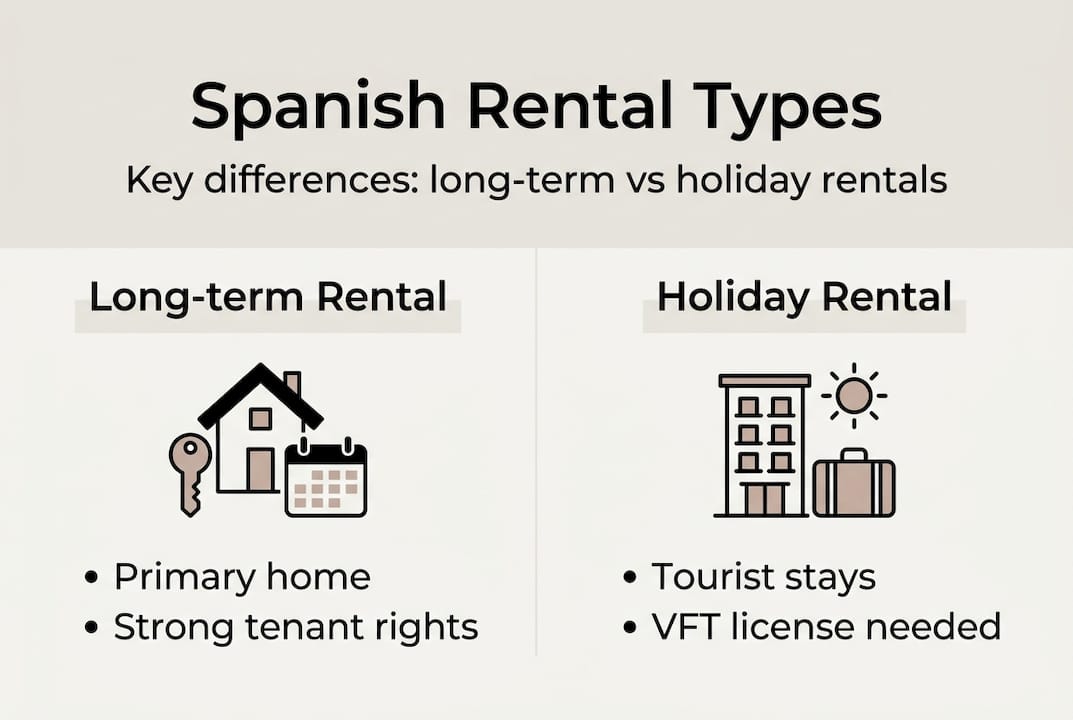
Long-term rentals are contracts of at least 12 months where the property serves as the tenant’s primary residence. These are governed by Spain’s Ley de Arrendamientos Urbanos (LAU), which gives tenants strong protections including mandatory renewal rights up to five years for individual landlords and seven years for companies. Rent increases are tied to official indexes, and eviction is a slow, court-driven process.
Holiday rentals are short stays, typically up to 31 days per guest or a maximum of two months. These require a VFT (Vivienda con Fines Turísticos) tourist license and, in Andalusia, must meet strict habitability and safety standards. As noted in tourist license requirements, community approval is also mandatory before you can legally operate. The types of Spanish rentals span a wide spectrum, and holiday lets sit at the most regulated end.
Seasonal rentals fall in the middle, running from 32 days to 11 months. They’re designed for temporary housing needs, like a student renting for a semester or a professional on a work assignment. The LAU applies partially, but tenant protections are weaker than in long-term contracts. These rentals do NOT require a tourist license, which makes them attractive to owners who want flexibility.
Here’s a quick comparison of the three types:
| Attribute | Long-term | Holiday | Seasonal |
|---|---|---|---|
| Duration | 12+ months | Up to 31 days / 2 months | 32 days to 11 months |
| Tourist license | No | Yes (VFT) | No |
| Primary residence | Yes | No | No |
| Tenant protections | Strong (LAU) | Minimal | Moderate |
| Owner flexibility | Low | High | Medium |
Key legal obligations for each rental type:
- Long-term: Register the contract, provide a habitable property, follow LAU renewal and eviction rules, limit deposit to two months
- Holiday: Obtain VFT license, meet Andalusian safety and habitability standards, get community approval, register guests with police
- Seasonal: Written contract specifying temporary purpose, partial LAU compliance, no tourist license needed
Pro Tip: Seasonal rentals attract flexible tenants and skip the tourist license process, but if a tenant uses the property as their main home, a court may reclassify it as a long-term contract, triggering full LAU protections you didn’t plan for.
As idealista confirms, holiday rentals require strict VFT licensing while long-term rentals come with strong tenant protections as primary residences, making these two models fundamentally different legal animals.
Comparing yields, costs, and risks for property investors
With definitions set, we can look at how the financial realities and risks stack up for owners.
The headline numbers for holiday rentals on the Costa del Sol look attractive. Gross yields can reach 8% to 12% in high-demand tourist zones. But gross yields can mislead, as management fees, platform commissions, cleaning costs, and seasonal vacancies eat into that figure fast. Long-term rentals typically generate gross yields of 4% to 6%, but net returns after costs are often more predictable and sometimes competitive.

Here’s how the two main models compare financially:
| Factor | Holiday rental | Long-term rental |
|---|---|---|
| Gross yield | 8% to 12% | 4% to 6% |
| Management cost | High (15% to 25% of revenue) | Low (8% to 12%) |
| Net return | Variable, seasonality-dependent | Stable, lower variance |
| Legal/regulatory risk | High (bans, moratoriums) | Low to moderate |
| Vacancy risk | High in off-season | Low |
Key cost items every investor should account for:
- Property management fees (higher for holiday lets due to turnover)
- Platform commissions (Airbnb, Booking.com typically take 15% to 20%)
- Cleaning and laundry between guest stays
- Advertising and photography for listings
- Maintenance and repairs (holiday lets see faster wear)
- Insurance premiums (holiday lets require specialized coverage)
Understanding your property management needs upfront helps avoid surprises. And reviewing rental insurance differences between holiday and long-term lets is equally important since standard home insurance often doesn’t cover short-stay guests.
Regulatory risk is the factor most investors underestimate. Málaga city has introduced a moratorium on new holiday rental licenses in certain districts. Homeowner communities can vote to ban tourist rentals. These aren’t hypothetical threats. According to this rental investment ROI guide, holiday rentals offer higher gross yields but carry greater costs, seasonality exposure, and regulatory risk, while long-term rentals deliver lower gross but more stable net returns.
Pro Tip: Always run your numbers on net yield, not gross. A 10% gross yield that drops to 5% net after fees and vacancies is no better than a stable 5% long-term let with far less hassle.
Legal protections and obligations for landlords and tenants
The profitability of each option depends partly on how law protects or constrains you as a landlord or tenant.
Spanish law treats these rental types very differently. Long-term tenants have some of the strongest protections in Europe. Evictions can take 12 to 24 months through the courts. Landlords cannot raise rent freely, must maintain the property to habitability standards, and cannot terminate early without cause. Deposits are capped at two months for unfurnished properties.
Holiday rental tenants, by contrast, have almost no legal protections beyond basic consumer rights. Owners can set their own rules, adjust prices freely, and remove guests at the end of their booking without any legal process. But the obligations on the owner side are heavy.
What landlords must provide in each framework:
- Long-term: Habitable property, working utilities, compliance with LAU renewal terms, formal eviction process if needed
- Holiday: VFT license, guest registration with local police (within 24 hours of arrival), fire safety equipment, first aid kit, complaints book, habitability certificate
- Seasonal: Written contract with clear temporary purpose, basic habitability, partial LAU compliance
Fines for unlicensed holiday rentals in Andalusia can reach €150,000 for serious infractions. Operating without a VFT license is classified as a serious offense under regional tourism law.
As the guide to tourist rental licences in Andalusia explains, long-term rentals carry strong tenant protections under LAU while holiday lets place the compliance burden squarely on the owner. Reviewing the legal protections in rentals that apply to your situation is a step most owners skip until something goes wrong.
For context on how holiday and seasonal frameworks differ in practice, the rental regulation overview breaks down where the legal boundaries sit and why the distinctions matter for both owners and guests.
Which rental type fits you best? Use cases and expert strategies
Understanding obligations is great, but ultimately you’ll want to decide which approach fits your goals and risk style.
There’s no universal answer. The right rental type depends on your property’s location, your appetite for active management, your tax situation, and how long you plan to hold the asset. Here’s a practical breakdown of who benefits most from each model:
- Holiday rental: Best for owners in high-tourism zones like Torremolinos, Marbella, or Nerja with a VFT license already in place, who can handle or outsource active management
- Long-term rental: Best for investors who want predictable income, minimal management, and lower regulatory exposure, especially outside peak tourist corridors
- Seasonal rental: Best for owners who want flexibility without a tourist license, targeting students, professionals, or digital nomads staying two to ten months
- Hands-off investor: Long-term lets with a local property manager offer the lowest stress and most predictable returns
- Remote owner: Holiday lets with a full-service management company can work, but fees will significantly reduce net yield
Hybrid strategies are increasingly popular on the Costa del Sol. Owners run holiday lets from June through September when occupancy and rates peak, then switch to a seasonal or long-term let from October through May. This approach balances peak-season income with off-season stability. If you’re exploring finding holiday rentals as a starting point or considering mid-term and seasonal alternatives, both options have real merit depending on your timeline.
However, as this short-term vs long-term guide notes, hybrid approaches carry reclassification risks if seasonal contracts are used improperly or if a tenant establishes primary residence during the winter period.
Pro Tip: Never use a seasonal rental contract for someone who will clearly be using the property as their main home. Courts look at actual use, not what the contract says, and reclassification to a long-term tenancy can happen quickly.
Why the best rental strategy isn’t always obvious, even for experienced owners
Before you decide, it helps to consider what even seasoned property owners tend to overlook.
We’ve seen owners chase 10% gross yields on holiday lets, only to find that community bans, platform algorithm changes, or a single regulatory update wiped out their advantage within a year. The Costa del Sol market moves fast. What worked in 2022 may not work in 2026. Málaga’s moratorium on new holiday licenses is a real signal that local governments are tightening supply, which raises the value of existing licenses but also concentrates risk.
Long-term rentals feel safe until you encounter a non-paying tenant and realize the eviction process can run 18 months. Seasonal lets feel clever until a court decides your “temporary” tenant actually lives there full time.
The honest truth is that every rental model carries hidden risk. The difference between a smart investor and a frustrated one often comes down to how well they understand the local regulatory environment before committing. Reading expert perspectives on rental platforms versus traditional agency models is a useful starting point for calibrating your expectations. Strategy should be reviewed annually, not set once and forgotten.
Expert help for your next Spanish rental decision
If you want help choosing or managing your ideal rental option, here’s how you can get expert advice.
Navigating Spain’s rental landscape, from VFT license applications to long-term contract compliance, is genuinely complex. Getting it right from the start saves money, time, and legal stress.

At SteraM Flats, we specialize in exactly this kind of guidance for property owners and investors across southern Spain. Whether you’re deciding between holiday and long-term models or need hands-on management for an existing property, our team handles the details. Explore our full rental and real estate services or browse our curated holiday rentals from SteraM Flats to see what’s available in Torremolinos and beyond. We’re here to make the process straightforward.
Frequently asked questions
What documents are needed for a holiday rental in Andalusia?
Holiday rentals require a VFT tourist license, a municipal compatibility report, a habitability certificate, and written community approval before you can legally operate.
How long can a long-term rental contract last in Spain?
Long-term contracts must be at least 12 months, with mandatory extensions up to five years for individual landlords and seven years for corporate landlords under LAU rules.
Are holiday rentals in Spain subject to different taxes than long-term lets?
Yes. Holiday rental income is 100% taxable for non-residents, while long-term rental income is only 50% taxable for residents, though expenses are deductible in both cases.
What are the risks of using seasonal rentals as a legal loophole?
Seasonal rentals avoid tourist licensing but risk reclassification as long-term contracts if a tenant uses the property as their primary home, triggering full LAU tenant protections.
Can communities in Spain ban holiday rentals?
Yes. Homeowner communities can ban tourist rentals with a three-fifths majority vote, while long-term rentals are not subject to community prohibition.